Supporting Shipibo-Konibo Women Artisans with Futuro Nativo
In the native community of San Francisco on the Ucayali River, a group of Shipibo-Konibo women set out to build something they had never had — a shared space to make and sell their work. Soltara helped fund phase 1, in collaboration with Futuro Nativo.
Where the project is
The Shipibo-Konibo have lived along the Ucayali River, a major tributary of the Amazon, for generations. The native community of San Francisco sits in the Ucayali region of the central Peruvian Amazon, not far from the port city of Pucallpa.
That proximity has shaped the last century of Shipibo life. Pucallpa grew quickly during the rubber boom of the early 1900s, bringing settlement and extraction into Shipibo-Konibo territory. From the 1950s onward, sustained missionary activity pressed for religious conversion.
Shipibo-Konibo communities have held onto a great deal through all of it — their language, which belongs to the Panoan family, their healing practices, and their art. But the pressure has not stopped. Deforestation and a changing climate are making it harder to hunt, fish, and grow food. Families increasingly relocate to cities for schooling, healthcare, and income.
Every one of those moves carries a cost to cultural continuity.
What kené is
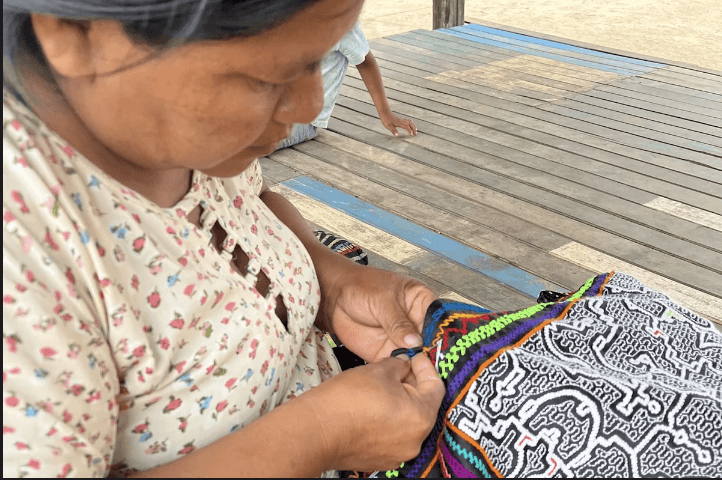
Shipibo-Konibo textiles and ceramics are known worldwide for their geometric designs — dense, maze-like patterns that seem to continue past the edge of the cloth. They appear in a wide range of colors.
These designs are called kené. Each pattern carries meaning drawn from Shipibo cosmology, from the master plant teachers of the Amazon, and the designs are closely tied to the visions healers see in ceremony. A finished textile holds a story.
Women are the primary artists in Shipibo-Konibo communities, and they hold significant authority in community life. When a woman teaches her daughter to weave kené, she is passing on far more than a technique.
This is what cultural preservation actually looks like in practice. It happens through hands, materials, and time spent together — one person showing another how a pattern is made and what it means. It requires that people have the space and the economic stability to keep doing it.
The problem the center solves
For the women of the Inin Rao family in San Francisco, there was no shared place to work. Each woman made her crafts alone, in her own home.
Working alone limits what is possible. It makes it harder to teach, harder to pool materials, harder to reach buyers, and harder to command a fair price. The sale of handicrafts is one of the main sources of independent income for Shipibo women and their families, and doing it in isolation means capturing far less of that value.
The proposal was direct: build one space where the women could gather, work as a collective, sell together, and teach the next generation.
Phase 1: the building
Phase 1 had a single objective — construct a 12 x 10 meter craft space in San Francisco.
The budget was $5,000, itemized down to the nails: timber, slats, corrugated roofing, hardware, project management, and a site visit. Soltara covered roughly 30% of that total, alongside other supporters.
Phase 1 is complete. The building stands. The women of San Francisco now have a place to gather, produce, and sell their work as a collective, and a foundation for everything the community wants to build next.
Phase 2: what comes next
With the structure up, the project — now called the Kene Xobo Arts & Cultural Center — has a much larger set of goals. Phase 2 is still fundraising. It covers:
- Finishing and furnishing the center — painting, repairs, weaving equipment, and the materials needed to host visitors
- Reforesting 2 hectares around the center with upwards of 1,000 native trees, medicinal plants, and flowering plants, to restore soil health, bring back pollinators, and rebuild habitat that deforestation has thinned
- Establishing a plant-based pharmacy — a medicinal garden of traditional Shipibo-Konibo healing plants, cultivated and taught by the women of the community
- Hosting cultural immersions — weaving and natural-dye workshops, plant saunas and traditional massage, and time spent learning the meaning behind the designs
- Building distribution channels so the artisans can reach national and international buyers directly
The reforestation and the pharmacy are the same work as the weaving, approached from a different angle. Traditional healing knowledge is held in the same way kené is: by being practiced, and by being taught to someone younger.
Seeing the whole culture
One goal in the Phase 2 brief deserves particular attention, because the community shared it themselves.
Many visitors come to Shipibo territory for one reason: to participate in Ayahuasca ceremonies. The community has said they want visitors to encounter more of who they are. Ayahuasca is genuinely central to Shipibo spiritual life — it is woven through the cosmology that produces kené. It also sits inside a much larger world of art, medicine, language, food, and daily life that most outsiders never see.
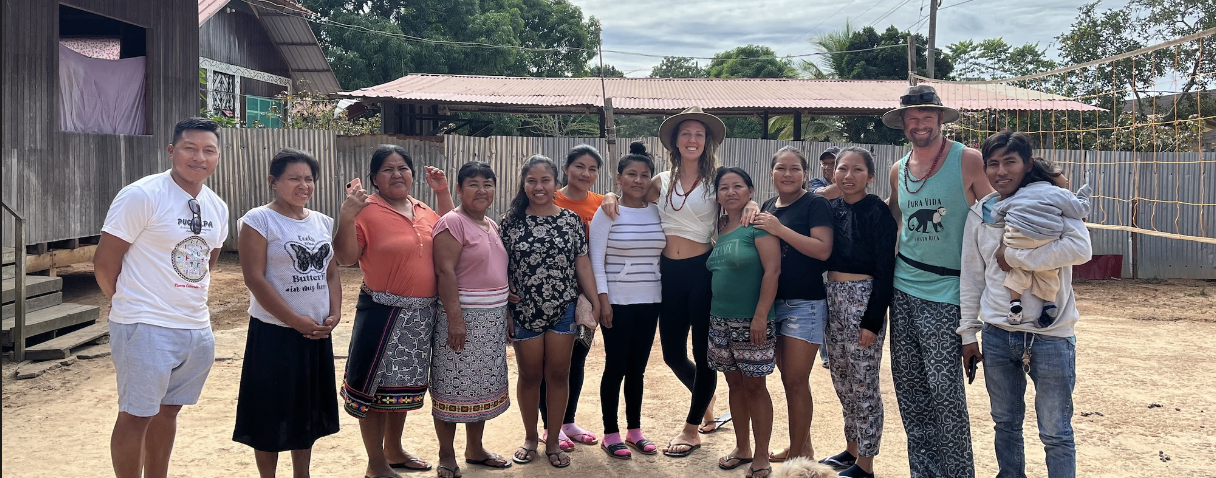
The immersions at Kene Xobo are designed to open that wider view. Visitors weave. They learn what the patterns mean. They work in the medicinal garden and plant trees. They spend ordinary time with Shipibo-Konibo women.
For Soltara, this is a request worth listening to closely. The Shipibo tradition belongs to the Shipibo people, and how it gets represented to the world should be shaped by them.
Why we supported it
The Kene Xobo center is Shipibo-Konibo women deciding what their community needs and building it. Outside funding removed a constraint. Every decision about what the center is for came from the community itself.
That is the kind of project we want to support: Indigenous-led, grounded in place, and built to last.
Irake — thank you.
Learn more about the Kene Xobo Arts & Cultural Center and support Phase 2 at futuronativo.org. Read about Soltara's broader reciprocity work on our Reciprocity page.