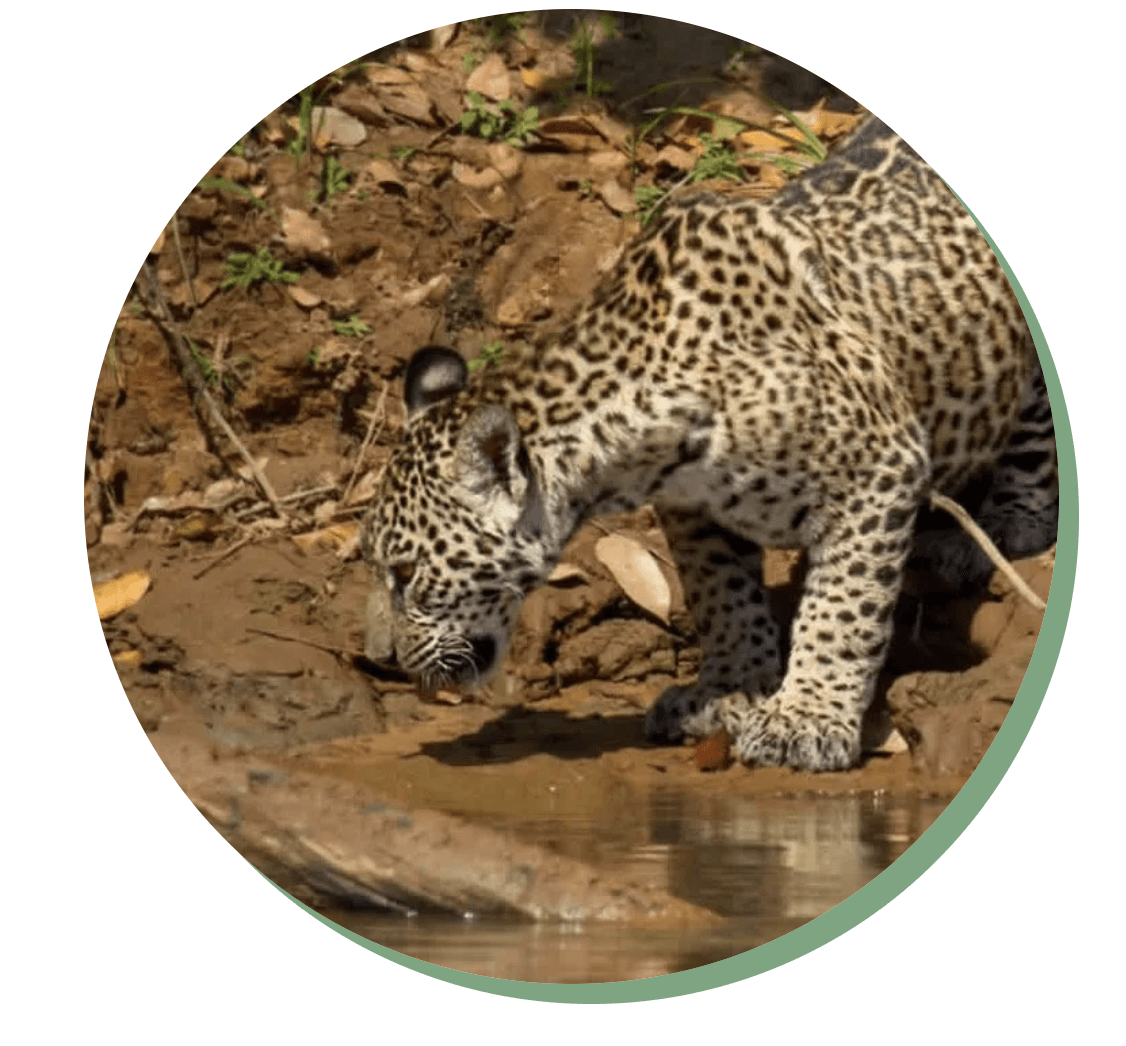
Protecting a Wildlife Corridor in the Peruvian Amazon
Soltara partnered with the Amazon Rainforest Conservancy on a $10,000 matching campaign to help protect a stretch of forest where jaguars, Andean bears, and tapirs still travel.
Who the Amazon Rainforest Conservancy is
The Amazon Rainforest Conservancy (ARC) is a registered Canadian charity working to protect and restore rainforest habitat in Peru. They work through two Peruvian sister organizations: Amazon Rainforest Conservancy Northern Peru (ARCNP) and Peruvian Amazon Rainforest Conservancy (PARC).
Together they now protect roughly 2,550 hectares of rainforest, across two very different landscapes — a Brazil nut concession in the lowland forest of Tambopata, and a cloud forest valley in northern Peru.
The second of those is the project Soltara helped fund.
The gap in the map
In the San Martín region of northern Peru, a valley sits between the two mountain ranges of the Cordillera Escalera Conservation Area.
The mountains on either side were given protected status in 2005. The valley between them was left out, because around 170 cattle-ranching families were living and working there.
The result is a gap in an otherwise protected landscape. Camera trap footage confirms that jaguars, Andean bears, and tapirs move through the valley regularly. Animals that try to cross are often shot.
Habitat fragmentation is one of the most serious threats facing large mammals in the Amazon. When protected areas are cut off from one another, populations become isolated, gene pools shrink, and animals are pushed into contact with people. Closing the gap matters as much as protecting the land on either side of it.
For jaguars, the Amazon is the last real stronghold. Research published in the journal Oryx estimates around 64,000 jaguars across the Americas, with roughly 90% of them living in a single Amazonian population. The other 33 identified subpopulations hold about 7,000 animals between them, and nearly all are classified as Endangered or Critically Endangered. Other studies put the global total higher, closer to 173,000. The distribution finding is consistent either way: the Amazon is where jaguars still have room to move.
Which makes a valley they already travel through worth protecting.
ARCNP's approach is straightforward: buy land in the valley from retiring farmers, parcel by parcel, and reconnect the corridor.
Soltara's matching campaign
Soltara committed $10,000 in matching funds to ARC's land acquisition work, doubling every donation that came in during the campaign. The funds went directly toward purchasing parcels in the valley.
ARC recognized the campaign in their 2022 Impact Report:
"Soltara Healing Center stands in solidarity with the Amazon Rainforest Conservancy in protecting the Amazon and its wildlife. We are honored and grateful to support the ARC's initiative to create a wildlife corridor and promote sustainable living for the families living in the valley. So much of our work is in connection with the Amazon and its human and non-human beings, and we are committed to reciprocity in our education and our action. We appreciate the opportunity to support this initiative, and ARC's continued and tireless commitment to conservation and sustainability in this precious and important region."
— Melissa Stangl, Founding Partner & COO, Soltara Healing Center
Where the corridor stands now
The project has kept growing since then. As of ARC's most recent reporting, ARCNP has:
- Purchased 14 farms totaling 235 hectares (581 acres)
- Signed an agreement with the Regional Environmental Authority of San Martín granting stewardship of an additional 1,730 hectares (4,275 acres) inside the Cordillera Escalera Regional Conservation Area, connected directly to the land already protected
- Trained five Forest Guardians — local community members who patrol the land and monitor for illegal activity
- Reforested 35 hectares (87 acres) of former pastureland
- Established 40 meliponine beehives to help restore populations of native stingless bees
- Planted 382 flowering plants to support hummingbirds and bees
They have also recorded camera trap footage of a healthy jaguar on protected land — the clearest possible sign that the corridor is doing its job.
Why we joined
The Amazon is where this medicine comes from. It is the home of the Shipibo communities Soltara works alongside, and the source of the plants at the center of the work.
Beyond that, it is one of the most biodiverse places on Earth and a major regulator of the global climate. The forest matters whether or not anyone ever sits in a ceremony.
Reciprocity, for us, extends to the land as much as to people. Supporting the communities who hold this knowledge and supporting the forest that sustains them are part of the same commitment.
As Maestra Karina shares, "proteger la vida también transforma la nuestra" - protecting life also transforms our own.
Irake
To everyone who donated during the matching campaign, and to the ARC and ARCNP teams doing this work on the ground in Peru — thank you.
And to every person who comes to Soltara: your journey here helps make this kind of support possible. The care extends outward, in every direction.
Irake.
Learn more about the Amazon Rainforest Conservancy at amazonrainforestconservancy.com, and about Soltara's reciprocity and conservation work on our Reciprocity page.